
Who Invented Cement and When Cement is one of the most influential materials ever created by humankind. It supports our homes, cities, bridges, and monuments, yet its origins are often overlooked. To truly appreciate modern construction, it is essential to understand Who Invented Cement and When, because this single invention reshaped architecture and engineering forever.
The question Who Invented Cement and When is not just about a date or a name; it is about centuries of human experimentation and innovation. From ancient builders to modern scientists, cement’s journey reflects humanity’s constant desire to build stronger, safer, and longer-lasting structures.
Early History of Cement in Ancient Civilizations
Long before modern industry existed, early civilizations experimented with materials that could bind stones together. These early binders were created by heating limestone to produce lime, which was then mixed with water and sand. While basic, these mixtures formed the foundation for future discoveries and help explain Who Invented Cement and When in a broader historical sense.
Ancient Egyptians used lime and gypsum mortars extensively in pyramid construction. These materials allowed massive stone blocks to be aligned and stabilized with impressive precision. Although not modern cement, these early mortars were crucial steps in understanding binding materials.
The Romans took cement technology to another level. By combining lime with volcanic ash, they created hydraulic cement that could set underwater. Roman structures such as aqueducts and harbors still stand today, offering valuable clues when historians explore Who Invented Cement and When and how ancient knowledge influenced modern science.
The Transition from Ancient to Modern Cement
After the fall of the Roman Empire, much of the advanced knowledge surrounding cement was lost. During the Middle Ages, builders relied mainly on simple lime mortars, which were weaker and less durable. This period marked a decline in construction quality across Europe.
As scientific thinking re-emerged during the Renaissance, builders began experimenting again. They studied ancient Roman ruins, trying to understand how those structures survived for centuries. These investigations were vital stepping stones toward answering Who Invented Cement and When in its modern context.
By the late 18th century, the Industrial Revolution created urgent demand for stronger materials. Expanding cities, factories, and transportation systems required a binder that could handle heavy loads. This demand set the stage for one of the most important inventions in construction history.
Who Invented Cement and When in the Modern Era
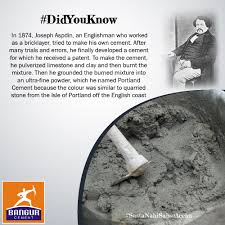
The modern answer to Who Invented Cement and When leads directly to Joseph Aspdin, an English bricklayer. In 1824, Aspdin patented a material he called Portland cement. He named it after Portland stone because the hardened cement resembled the stone’s appearance.
Aspdin created cement by heating a mixture of limestone and clay, then grinding it into a fine powder. When mixed with water, this powder hardened into a strong, stone-like mass. This invention marked the birth of modern cement and forever changed the construction industry.
Although Aspdin’s original formula was improved later by other engineers, his patent remains the defining moment in cement history. Today, when people ask Who Invented Cement and When, Joseph Aspdin and the year 1824 are widely accepted as the correct answer.
Evolution of Cement After Its Invention
After its invention, cement production expanded rapidly across Europe and North America. Industrial kilns and improved grinding methods allowed cement to be manufactured on a large scale. This made construction faster, cheaper, and more reliable than ever before.
Engineers continued refining cement formulas to improve strength, setting time, and durability. These advancements helped cement become the backbone of bridges, railways, dams, and high-rise buildings. Understanding these improvements adds depth to the question Who Invented Cement and When, showing that innovation did not stop with a single invention.
By the 20th century, cement had become a global industry. International standards ensured consistent quality, while scientific research introduced specialized cements for unique construction needs.
Types of Cement Developed Over Time
Ordinary Portland Cement (OPC) is the most widely used type today. It is valued for its versatility and strength, making it ideal for residential and commercial construction projects worldwide.
Other specialized cements include hydraulic cement, rapid-hardening cement, and sulfate-resistant cement. Each type was developed to solve specific construction challenges, demonstrating how cement technology evolved long after Who Invented Cement and When was first answered.
In recent decades, environmental concerns have driven innovation toward eco-friendly cement. These modern alternatives aim to reduce carbon emissions while maintaining performance, ensuring cement remains relevant in a sustainable future.
Impact of Cement on Modern Civilization
Cement has transformed the world more than almost any other building material. It enabled the rise of modern cities, allowing architects and engineers to design taller buildings and longer bridges with confidence and safety.
Economically, cement plays a vital role in development. Infrastructure projects powered by cement create jobs, support trade, and improve living standards. This widespread impact reinforces the importance of understanding Who Invented Cement and When and why the invention still matters today.
As populations grow and urbanization increases, cement will continue to shape the future. Innovations in sustainability promise to keep this ancient-yet-modern material at the heart of progress.
Conclusion
When we look back at history, the answer to Who Invented Cement and When becomes clear. While ancient civilizations laid the groundwork, modern cement was invented by Joseph Aspdin in 1824. His development of Portland cement revolutionized construction and enabled the modern world as we know it.
From ancient lime mortars to today’s advanced cement technologies, this material’s journey reflects human ingenuity and persistence. Cement remains one of the most important inventions in human history.
Frequently Asked Questions
Who is considered the father of modern cement?
Joseph Aspdin is considered the father of modern cement, providing the definitive answer to Who Invented Cement and When.
When was modern cement invented?
Modern cement was invented in 1824.
Did ancient civilizations use cement?
Yes, Egyptians and Romans used early forms of cement-like materials.
What is the difference between cement and concrete?
Cement is a binding material, while concrete is cement mixed with sand, gravel, and water.
Why is Portland cement so important?
It offers strength, durability, and versatility for nearly all types of construction.
Also Read: What Do Bass Eat